A fast launch makes a short video. Living with a performance car gives you a much longer set of questions. Electric cars make that contrast especially interesting: acceleration can be the first thing you notice, while the controls, charging routine, comfort, and consistency determine whether the car suits you.
Compare the complete driving and ownership experience. A headline power figure cannot describe your commute, your charging routine, or your next event.
Define the experience you want
List three things that make driving enjoyable for you. They might be steering feel, a compact cabin, a comfortable commute, clear controls, or the anticipation of an organized track day. Rank them before comparing specification sheets.
Then add the unglamorous constraints: parking, passengers, luggage, access to charging, and the distances you actually travel. A car that fits those requirements earns more opportunities to be enjoyed. You are not settling by considering them. You are describing the whole job instead of allowing a single acceleration number to choose the car for you.
Separate simulated feedback from hardware
Hyundai's 2026 IONIQ 5 N manual describes N e-Shift as virtual shifting created through motor control. That is different from assuming the EV contains the same multi-speed transmission as a conventional performance car. The manual also lists conditions in which the feature is unavailable.
The useful question is whether that kind of feedback adds enjoyment for you. Evaluate the specific vehicle and its settings rather than treating virtual feedback as either automatically authentic or automatically pointless. During an ordinary, lawful test drive, pay attention to whether the controls and responses make sense to you without distracting from the road.
Ask about repeatability, not just the best run
Hyundai's own IONIQ 5 N material distinguishes sprint and endurance priorities and describes battery preconditioning for different uses. It is an example of why peak output and repeated performance are different questions. Manufacturer descriptions are not an Autobros comparison test.
When reviewing any performance car, look for the conditions attached to a claim: starting charge, temperature, tires, mode, and how the result was measured. Do not compare one carefully prepared best run with another car's ordinary driving result. Keep unverified impressions and measured evidence in separate columns in your research notes.
Walk through an actual charging day
Choose a real day from your life and map when the car would be parked, how far it would travel, and where charging could happen. Check the exact car's connector, charging capabilities, and the sites you expect to use. A charging plan is a set of practical arrangements, not just a maximum kilowatt figure.
For an organized driving event, ask the venue about eligibility and charging facilities directly. Confirm what is available, whether access is shared, and what your fallback is. Do not assume that a charger shown on a map is an on-site service reserved for event participants.
Compare ownership on your terms
Build a shortlist using the same questions for every candidate. What do you enjoy? What is inconvenient? Which features do you understand? Which limitations matter to your routine? Add insurance quotes, service information, and actual ownership costs as separate research tasks before making a purchase decision.
Keep the conclusion personal and specific. A car can be impressive without being right for your household. A less dramatic option can be the one you use and enjoy more. Electric performance becomes a better conversation when it includes the whole experience instead of asking one stopwatch result to settle every preference.
A couple of good questions
Does a virtual shift feature mean an EV has a conventional gearbox?
No. In the cited IONIQ 5 N example, Hyundai describes motor-controlled simulation. Always read the documentation for the exact model and year.
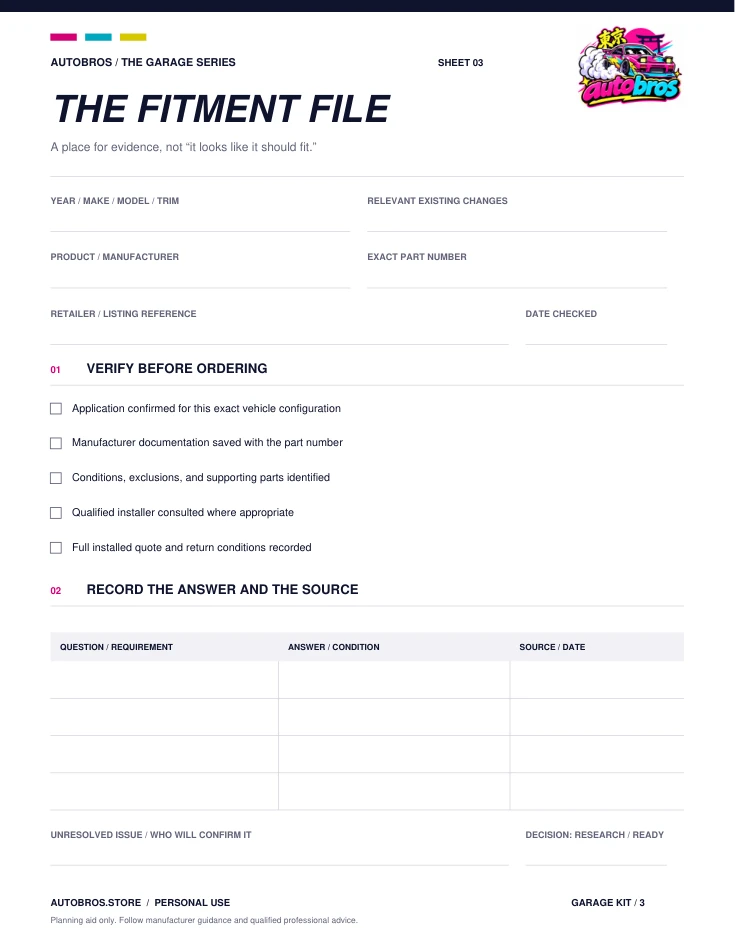
Fitment research sheet
One place for part numbers, compatibility questions, and sources.
Fill in the free worksheet Blank PDFReferences & further reading
Sources reviewed October 13, 2026. Product facts are manufacturer or retailer information, not an Autobros test. Confirm current instructions before acting.
Hyundai — 2026 IONIQ 5 N owner manual: N e-Shift Hyundai N — IONIQ 5 N energy management and battery preconditioning