Florida heat makes window tint appealing, but a 'legal tint' claim is incomplete without the window location, vehicle type and final visible light transmittance (VLT). This explainer is Florida-specific and current as of October 2026; it is informational rather than legal advice. Check the current statutory text and have an experienced installer verify your exact vehicle. Laws in other states may differ.
Measure the finished glass-plus-film assembly, verify the current Florida rules for each window, and get compliance details in writing.
Understand VLT before choosing a shade
Visible light transmittance is the percentage of visible light passing through the finished window system, including existing factory glazing and added film. A box labeled '35%' does not mean the final installed glass measures 35%. Lower VLT means less light passes through. Ask the installer for the expected reading and how they measure the finished window. Reflectivity limits are a separate requirement.
Front side windows: know the Florida minimum
Florida's 2026 section 316.2953 generally permits front side-window sunscreening material when the finished window passes at least 28% visible light and has no more than 25% visible-light solar reflectance, subject to the statute's conditions. The measurement is made on the specific vehicle's glazing-plus-film assembly. Do not rely on an unverified chart copied from another state or a retailer's film-only number.
Rear windows depend on vehicle classification
Under section 316.2954, different limits can apply to rear glazing on ordinary vehicles versus qualifying multipurpose passenger vehicles. The statutory provisions address visible light, reflectance and some other types of window covering. Before choosing a shade, ask the installer to identify the vehicle category and show which clause applies. If rear visibility is substantially altered, also discuss required mirrors and practical nighttime visibility.
Windshields are a different conversation
Florida section 316.2952 restricts signs and sunscreening materials on windshields, with specific exceptions such as a permitted top strip that stays outside the prohibited viewing area. Never assume a full windshield film is lawful simply because it is advertised as clear, UV-rejecting or nearly transparent. Ask for the exact legal basis and verify sight-line and safety-system compatibility.
Ask for labeling and documented compliance
Florida section 316.2955 describes installer/seller compliance labeling and tolerances. Confirm who supplies and attaches the required label, what brand/film was used, and whether you receive an invoice showing the measured final condition. Ask about any vehicle-related or medical exception through the appropriate official process rather than assuming a shop can issue one. Preserve your paperwork if you later replace glass or sell the vehicle.
Practical questions for your tint installer
Which exact film series are you installing? What VLT and reflectance will the finished front and rear windows measure? Does my vehicle count as a multipurpose passenger vehicle under the statute? Will this film affect antennas, rear defrosters, cameras or sensor housings? What cure period, cleaning method and warranty apply? An experienced shop should welcome precise questions and give defensible answers, not guarantee every dark shade is legal.
A couple of good questions
Is 20% tint legal on front side windows in Florida?
Do not judge by a film label alone. The 2026 statute generally requires at least 28% visible light transmission through the finished front-side window assembly.
Does factory privacy glass count?
Yes. Ask for a reading of the finished glass and any added film rather than relying on the film's advertised VLT.
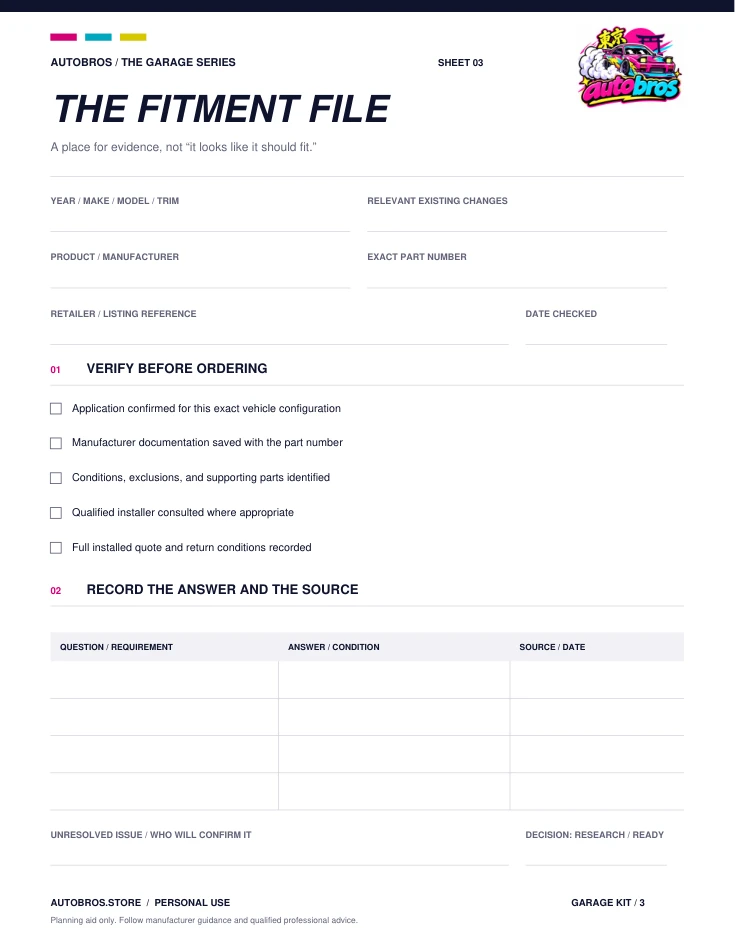
Fitment research sheet
One place for part numbers, compatibility questions, and sources.
Fill in the free worksheet Blank PDFReferences & further reading
Sources reviewed October 24, 2026. Product facts are manufacturer or retailer information, not an Autobros test. Confirm current instructions before acting.
2026 Florida Statutes §316.2953 — Front side windows Florida Statutes §316.2954 — Rear-side and rear windows 2026 Florida Statutes §316.2952 — Windshields 2026 Florida Statutes §316.2955 — Tint compliance labels