
Great interiors balance personality with daily use. A cleaner center console, better organization or a thoughtful material accent can make a bigger difference than fifteen mismatched accessories. The limitation: modern cabins are part of the vehicle's safety and electronic architecture. This guide treats that boundary as non-negotiable and favors simple, compatible changes.
Reversible, well-fitted interior changes often make a car feel better without touching airbags, belts, wiring or structural components.
Step 1 — Start with an interior moodboard
Take photos of the dash, seats, door cards and center console in daylight. Decide on two base materials and one accent color; note what already works. A black cabin with a single warm accent often reads more intentional than unrelated trim pieces. Consider fingerprints, glare, heat and cleaning before selecting glossy finishes. Make a simple reference sheet of the look you want so each purchase earns its place.
Step 2 — Fix clutter before buying accessories
Clear the footwells, remove unused cords and measure the actual storage spaces. Choose organizers that fit securely without blocking seat travel or access to controls. A phone mount should keep the screen out of your sight line and not interfere with airbag paths. Check every item while parked and seat positions are adjusted. Avoid loose objects that can become hazards during hard braking.
Step 3 — Choose floor mats that fit your vehicle
Floor protection sounds easy, but the wrong mat can interfere with the accelerator or brake pedal. Choose a design intended for your exact model and driver-side retention system. Never stack one mat over another or leave a driver's mat unsecured. After installation, check that all pedals return and operate freely with the vehicle stationary. If fitment is uncertain, do not use the product.
Step 4 — Make trim upgrades truly reversible
Consider removable accents or professionally applied interior films only where adhesives and removal methods are compatible with the substrate. Dashboard plastics, piano-black surfaces and soft-touch coatings have different tolerance to chemicals and heat. Test according to the manufacturer's guidance, and do not cover vents, sensors, switches, warning labels or anything that could interfere with an airbag. Photograph the original trim before changing it.
Step 5 — Treat lighting and audio as electrical projects
Ambient lighting should not distract the driver or impair nighttime visibility. Secure wiring so it cannot chafe, pinch under seat rails or interfere with safety electronics. Confirm the vehicle's electrical capacity, fuse requirements and compatibility before buying aftermarket modules. For hardwired lighting, amplified audio and cameras, a qualified installer is usually safer than trial-and-error tapping into unknown circuits. Keep the circuit diagram and receipts.
Step 6 — Leave restraint-system work to specialists
Seats, seat rails, steering wheels, belt anchors, airbag covers and occupant sensors are not ordinary cosmetic trim. Altering them can affect crash protection. Do not use seat covers or decorative add-ons that obstruct side-airbag deployment unless the vehicle maker explicitly approves the system and its application. If you want custom upholstery or steering-wheel restoration, use qualified specialists familiar with your exact vehicle's safety systems.
Step 7 — Finish with a usability test
Sit in every normal driving position. Reach controls without stretching, check mirror visibility, move the seats through their travel and confirm there are no loose cables or objects. Use the car for a normal week before adding more accessories. An interior that looks clean in photos but rattles, overheats or gets in the way is not a successful upgrade.
A couple of good questions
Are universal floor mats safe?
Only if they fit and secure exactly as required and never interfere with pedals. Vehicle-specific retention-compatible mats are preferable.
Can I change my steering wheel for style?
Changes can affect airbags, horn functions and steering safety; seek qualified professional advice instead of treating it as a cosmetic DIY project.
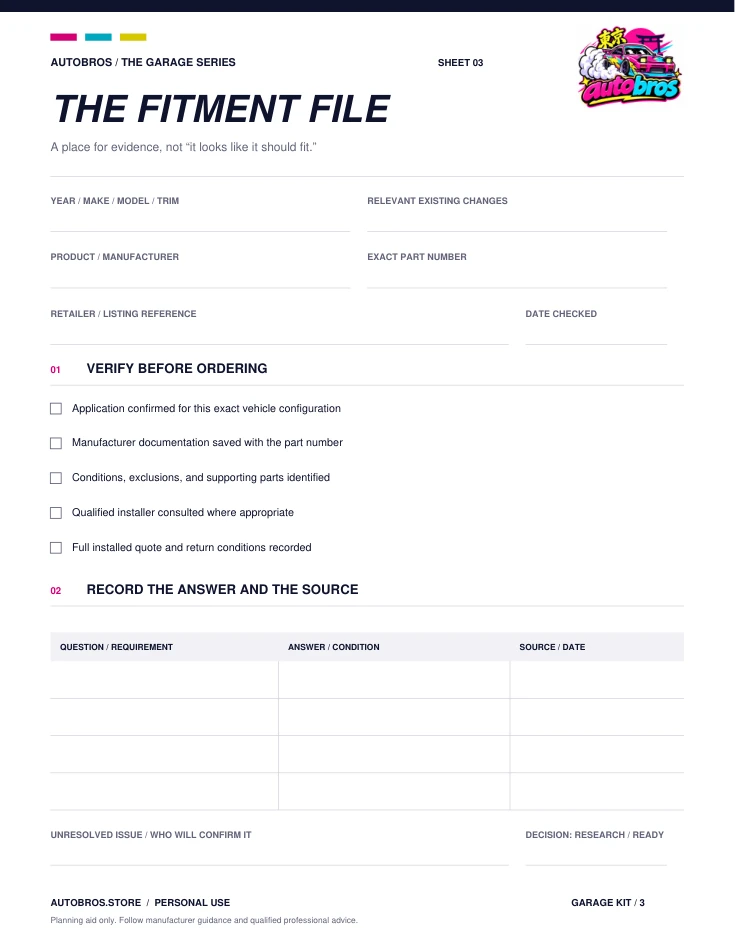
Fitment research sheet
One place for part numbers, compatibility questions, and sources.
Fill in the free worksheet Blank PDF