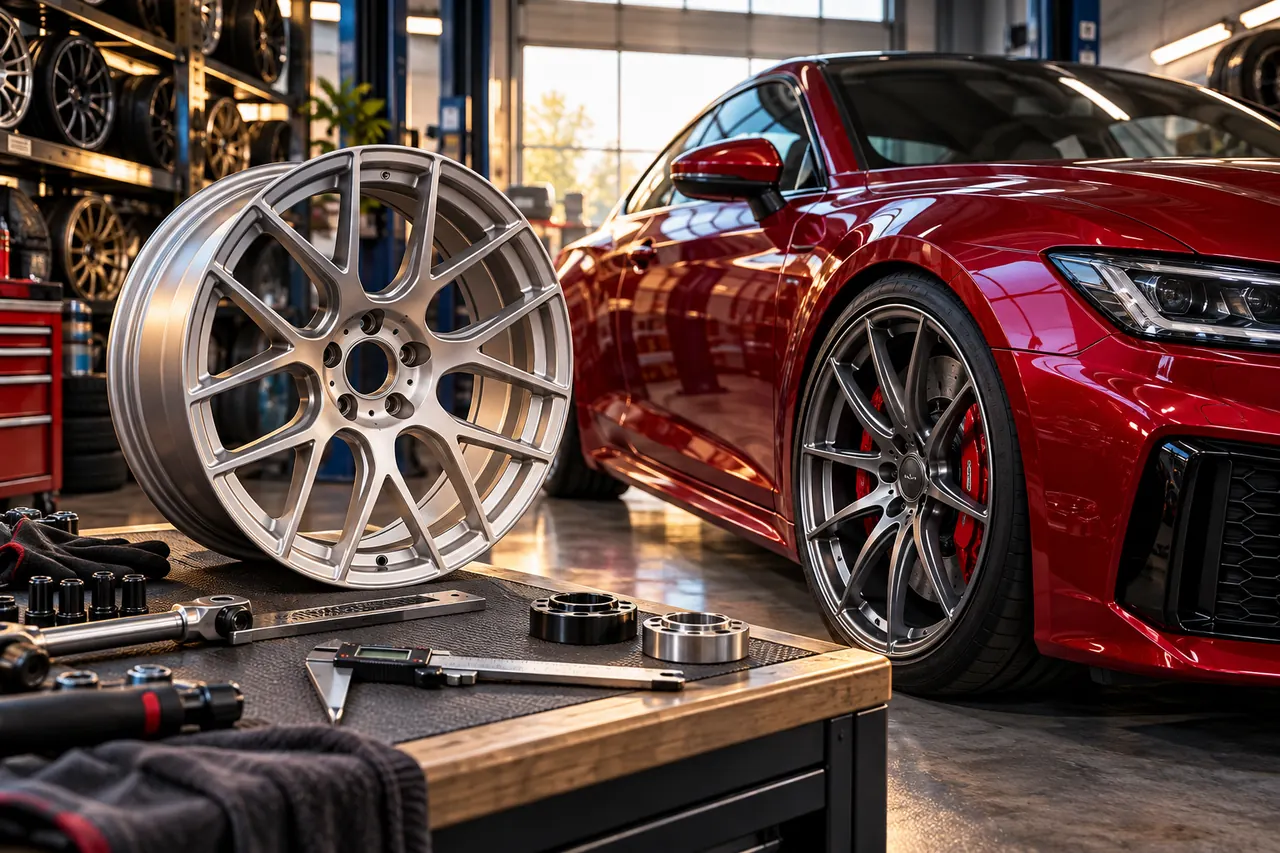
A wheel photo can tell you that you love the design. It cannot tell you whether the exact wheel and tire combination belongs on your exact car. Even a beautifully photographed build is missing important information unless its owner has documented the configuration.
Think of this guide as a briefing document for a supplier or installer—not as a fitment calculator. Its purpose is to help you ask a better question and keep the answer attached to the part you intend to order.
Love the look. Document the combination. Confirm before ordering.
Describe the car you have, not just the model name
Begin with year, make, model, trim, and market. Then list relevant changes and options you know about, especially anything involving the brakes, suspension, hubs, or existing wheel and tire setup. Put “unknown” where you do not know. A blank is better than an invented specification.
Keep the current wheel markings and tire information in your notes if they can be read safely. Record the source of each number. A previous owner’s message, a wheel stamp, and an installer’s written assessment should not all be treated as interchangeable evidence.
Tell the installer what you want the car to do. A daily-driven car and a styling project may have different priorities. Avoid making appearance the only question they are allowed to answer.
Understand offset without making it the whole story
Tire Rack describes offset as the distance between the wheel’s mounting face and its centerline, measured in millimeters. It also explains why a width change affects both sides of the wheel when offset stays the same. Neither number should be considered alone.
Here is a geometry example, not an application recommendation. Increasing nominal width from 8 to 9 inches adds 25.4 millimeters. At unchanged offset, half that nominal increase—12.7 millimeters—goes to each side. That arithmetic does not prove the real assembly clears anything on your car.
The example is useful because it exposes the wrong shortcut: “The offset is the same, so the fit is the same.” Ask a qualified supplier to evaluate the complete assembly and the real vehicle rather than converting a calculator result into a green light.
Make one evidence file for the exact combination
Ask for a written assessment tied to the specific wheel part number, diameter, width, offset, bolt pattern, center bore, tire specification, and intended vehicle configuration. Ask how load suitability, brake clearance, supporting hardware, and relevant manufacturer requirements are addressed.
You are not trying to become a fitment engineer in an afternoon. You are creating a record of what the people supplying and installing the parts have actually confirmed. A screenshot of “fits most models” is not the same as an answer about your configuration.
If the recommendation depends on another modification, write that dependency down before buying anything. “Should work after some changes” is still an unfinished assessment. Ask what the changes are, who approves them, and whether you are prepared to accept their implications.
Ask what happens outside the parked photo
A parked photograph presents one position, one angle, and one moment. Ask the installer how the proposed combination is assessed across steering and suspension movement, not simply whether the car can sit still with it installed.
Also ask what conditions make the recommendation invalid. A particular brake option, an undocumented modification, or a different tire variant might change the advice. Record these conditions next to the recommendation rather than at the bottom of a separate email chain.
Do not use this article to decide on spacers, adapters, stretched tires, altered bodywork, or suspension changes. Those need their own vehicle-specific evaluation. Treat any such dependency as a separate technical decision, not a small checkout accessory added to rescue an uncertain purchase.
Price the complete job and read the return conditions
A useful wheel budget should capture everything the supplier and installer say the approved job requires. Ask about tires, required hardware, sensors where relevant, installation, balancing, and any setup work the professional specifies. Do not assume the headline wheel price includes these items.
Read the seller’s actual return policy before ordering. Ask whether mounting, installation, special ordering, or visible marks affect returns. Keep the answer with the dated quote. Different sellers can have different conditions, so there is no universal return promise in this guide.
Confirm the exact SKU one more time before paying. Similar finishes, offsets, widths, and revisions can sit next to each other in a dropdown. Save the ordered specification and the supplier’s confirmation together so you can compare them with what arrives.
Make the handoff to installation boring—in a good way
Give the installer the same documentation you used for the purchase. Ask them to stop and contact you if the delivered item differs from the confirmed specification or the actual car differs from the description. A mismatch is not an invitation to improvise.
After installation, follow the relevant professional and manufacturer instructions rather than a generic torque value or internet checklist. Record the installed configuration and retain the documentation for future service and tire replacement.
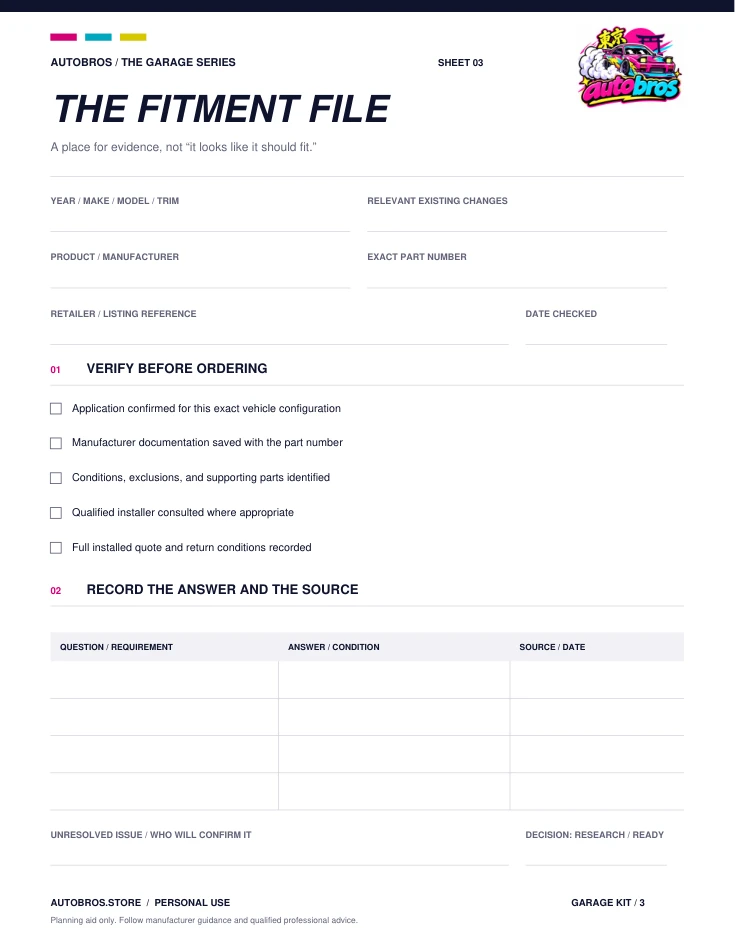
Use the free Fitment File worksheet to organize questions, answers, and dates. It does not certify anything. Its value is much simpler: it prevents a good-looking screenshot from becoming the only evidence behind an expensive decision.
A couple of good questions
Will entering my car in Autobros confirm fitment?
No. Vehicle information in My Garage is a planning record only. Obtain application guidance from the supplier and a qualified installer.
Can I copy the setup from another owner’s photo?
Use it as inspiration and a starting question. Do not treat an undocumented photo as approval for your vehicle.
Fitment research sheet
One place for part numbers, compatibility questions, and sources.
Fill in the free worksheet Blank PDFReferences & further reading
Sources reviewed September 29, 2026. Product facts are manufacturer or retailer information, not an Autobros test. Confirm current instructions before acting.
Tire Rack — What is wheel offset?