
You do not need a showroom garage to enjoy working on a car project. You need to be able to find the relevant supplies, understand what is waiting for a decision, and put things away without starting a second project.
This is an organizational approach, not a building, electrical, or workshop-safety specification. Use the applicable instructions and qualified advice for shelving, installation, loads, chemicals, and equipment. The useful first step costs nothing: decide what the garage must still allow you to do.
A useful garage makes the next step obvious—and putting things away possible.
Protect the jobs the space already has
Before shopping for organizers, describe the nonnegotiable uses of the space. Perhaps a vehicle must park there every night. Perhaps the household needs an unobstructed route through it. Perhaps another person uses the same storage. Write these needs down together instead of discovering the disagreement halfway through the reset.
Mark the area available for your project without blocking the routes and access that must remain clear. Do not fill every empty wall simply because a cabinet would fit in a photo. Consider doors, utilities, and the requirements of the equipment already there.
Choose one finishable area for the first session: a shelf, a drawer, or the detailing station. “Organize the entire garage” is a good ambition and a poor Saturday task.
Sort by the decision each item needs
Make four temporary groups: keep and locate, belongs elsewhere, needs a decision, and disposal requiring the appropriate route. Do not combine household waste with unidentified automotive chemicals or materials. Keep original labels and seek the relevant local guidance where disposal is uncertain.
The “needs a decision” group is the important one. Put an owner and a next action beside each item. A box labeled “stuff” preserves the uncertainty. A box labeled “confirm part number before Friday” creates a task.
For unfinished projects, record what the item belongs to and what would let it move forward. You might discover that the real obstacle is a missing answer, not a lack of shelving.
Give frequent routines the shortest route
Organize for how you actually work. Supplies used for an ordinary wash belong together if their storage instructions allow it. A rare project can have a separate labelled location. The system should make common tasks easier to start and easier to finish.
Put small-item labels where you can read them before opening the container. An inventory can identify a bin by location, purpose, and project rather than requiring you to memorize what “drawer three” contains. Preserve part numbers and supporting documentation where those matter.
Test the setup by walking through one real task from preparation to put-away. Notice the awkward reaches, repeated trips, and unclear decisions. Adjust the arrangement before spending money to make an inconvenient layout permanent.
Separate clean supplies, used supplies, and unknown supplies
Use distinct places for ready-to-use detailing textiles and items awaiting their specified cleaning or replacement. The visual separation can be as simple as labelled existing containers. The important part is that a person can tell which state an item is in without guessing.
Store chemicals according to their labels and applicable guidance, not according to whichever matching bottle system looks best. Retain identity and warnings. Ask an appropriate professional about any storage conflict rather than improvising a solution from this article.
Keep items of unknown condition out of the ready-to-use group until their condition and intended use are established. A good organization system should expose uncertainty rather than hide it neatly behind a cabinet door.
Measure the problem before buying the organizer
Write down what must fit: item dimensions, useful access, placement restrictions, and the manufacturer’s relevant mounting or load requirements. Decide whether a simple portable container does the job before choosing a wall system or a new cabinet.
For a textile kit such as The Rag Company’s Classic Detailing Kit, check the current contents before deciding what storage is needed. A bundle is not a storage strategy, and an empty organizer is not a reason to buy more supplies.
Take a photo and a set of notes to the store or product page. Compare dimensions and instructions to the actual space. Avoid using a shelf’s appearance as evidence that it can support the intended load or be installed on your particular wall.
End with an inventory and a ten-minute reset
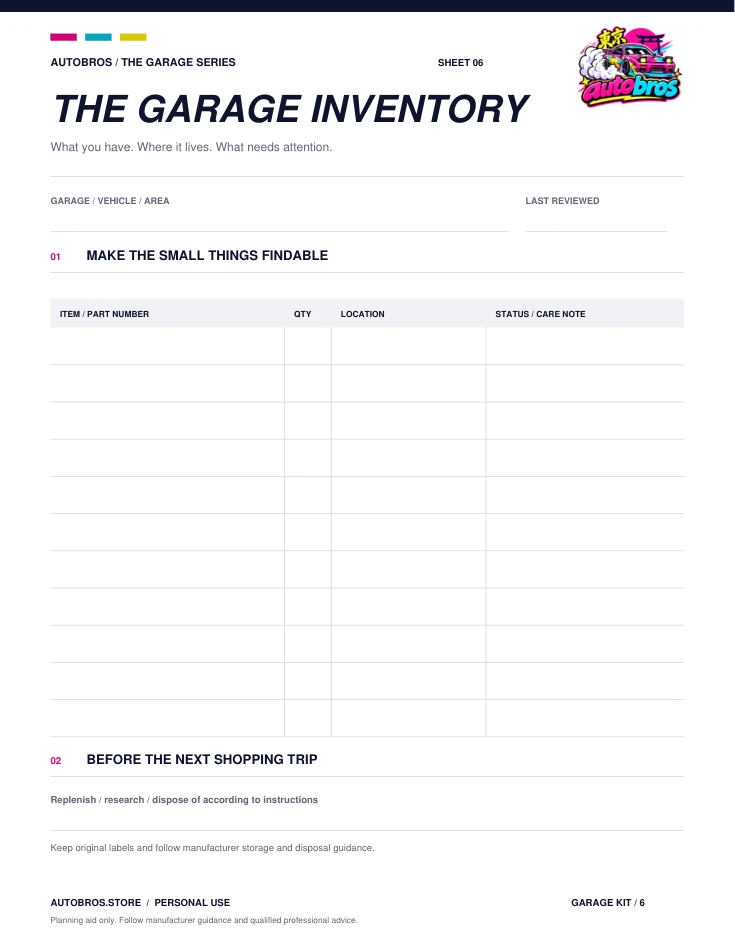
Create a short location guide: item or category, quantity you counted, storage location, and next action if any. Record quantities only as precisely as you will maintain them. “One bin of confirmed fasteners for project A” may be more useful than a detailed count that nobody updates.
Choose a small reset habit. At the end of a session, return tools, identify items needing attention, and write the project’s next action. The proposed ten-minute limit is a convenience, not a tested productivity promise. Adjust it to the task.
After a week, review what remained easy and what drifted back into a pile. Change one thing. The goal is not to maintain an elaborate catalog; it is to remove the friction that keeps you from enjoying the space you already have.
A couple of good questions
What should I buy first?
Start with the inventory and one clearly defined storage problem. Reuse suitable containers before committing to a larger system.
Can Autobros approve a shelf or mounting method?
No. Follow the product’s mounting and load requirements and get qualified advice for your location and intended use.
Garage inventory
What you have, where it lives, and what needs replenishing.
Fill in the free worksheet Blank PDFReferences & further reading
Sources reviewed September 29, 2026. Product facts are manufacturer or retailer information, not an Autobros test. Confirm current instructions before acting.
The Rag Company — Classic Detailing Kit