There is a version of your dream car living in your browser tabs. It has the wheels, the stance, the little details, and absolutely no invoice for installation. That last part is the problem.
A useful build budget should describe a finished, usable next chapter—not a collection of attractive part prices. Here is an Autobros planning method for getting from “I want to do everything” to one decision you can make confidently. The numbers below are invented examples for explaining the method, not market quotes.
The best first upgrade is a project you can actually finish.
Give the car one job for this stage
Write a sentence beginning, “For the next three months, I want this car to…” Be specific enough that it can reject purchases. “Be a tidy, dependable daily that I enjoy taking to meets” is more helpful than “be amazing.” “Complete my first instructed event” creates a different list.
Then write what is outside this stage. Perhaps you are not chasing additional power, changing the interior, or rebuilding the entire suspension. That is not giving up. It is protecting the project from having six competing definitions of success. Put a tempting but unrelated idea in a later list instead of trying to justify it today.
Your finish line should be observable: a resolved issue, a documented inspection, a completed cleaning routine, or an event booked after its requirements are understood.
Separate baseline needs, the next improvement, and the dream list
Start by recording what you know about the car and what you still need a qualified person to assess. Do not turn an unexplained noise into a shopping recommendation. “Identify the noise” is a legitimate project task; “buy the popular replacement” is a guess.
Use three headings. Baseline needs come first. The next improvement contains one coherent job. The dream list holds everything else. Treat the first heading as a conversation with the relevant manual and professional, not a universal maintenance schedule downloaded from a blog.
For a simple ownership habit, NHTSA recommends checking tire pressure monthly when cold and using the vehicle’s placard or manual. That is the kind of documented reference worth keeping beside the build plan. It is not a reason to copy another owner’s pressure setting.
Ask for the complete installed number
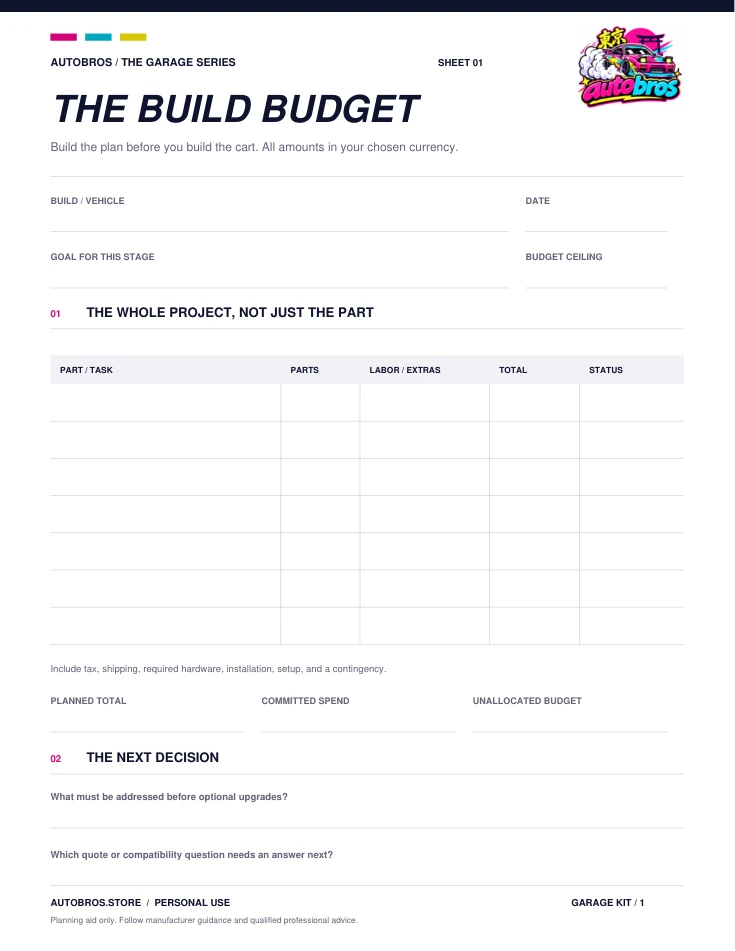
For each potential change, create separate fields for the main item, required supporting items, labor, setup or calibration where applicable, tax, shipping, and any follow-up work. Add a field for the quote date and one for exclusions.
Suppose a fictional project has a $400 item, $180 of labor, $75 of supporting materials, and $45 of tax and delivery. The planned project is $700, not $400. These are illustrative inputs; the point is the addition, not a suggested price for any particular job.
Ask the supplier what is not included. Ask the installer which supporting items they require. Ask who handles a mismatch discovered before installation. An incomplete quote can look attractively precise. The budget becomes useful only when you understand what that number buys.
Keep estimates and money already committed apart
Give every line a status: researching, quoted, ordered, or completed. Keep an estimate column and an actual-cost column. An item in a cart is not money spent; a deposit is not a free reservation. Record a deposit once against the project rather than adding it again when the balance is paid.
Use a deliberately simple rule: committed costs plus the remaining estimates for unfinished work plus an explicitly chosen reserve must fit inside your stage budget. Do not count the same purchase in two statuses. If a new quote changes the total, change the plan before placing another order.
The reserve is your decision, not a magic percentage that makes every build affordable. If the numbers no longer fit, reduce the stage, delay it, or ask for a different scoped solution.
Buy in the order that removes uncertainty
Before every purchase, write the question it answers. A written application confirmation can remove more uncertainty than another accessory. An assessment can change the entire order of work. A sample can prevent committing to a finish you dislike.
Try a short buying gate: the item has a defined job; its exact version is recorded; any compatibility question is resolved; the complete cost fits; and there is a realistic time and place to complete the work. A “not yet” on one of these is information, not failure.
For nonessential purchases, leave the item in the plan until your next scheduled review. This is especially useful when a sale deadline is trying to make the decision for you. A discount does not make an unrelated part part of your current stage.
Make the next weekend finishable
End the budget session by assigning one next action, one person, and one date. “Improve the car” is not an action. “Ask the installer to confirm the written quote and its exclusions by Friday” is.
After the work, record the final cost, what changed, and what you learned. Keep a receipt reference rather than publicly sharing private documents. Photograph the result only where it is safe and appropriate. Then decide whether the next stage still makes sense.
Use the free Build Budget sheet to start on paper, or My Garage to hold local notes. Neither tool verifies parts compatibility. Their job is to keep your decisions visible so that progress looks like a finished chapter rather than a growing collection of unopened boxes.
A couple of good questions
Should I buy everything during a sale?
Only when the exact items are already confirmed and the complete project still fits your budget. Treat a sale as a possible price change, not as a new project goal.
Does a saved garage item mean it fits my car?
No. My Garage stores your notes and estimates. It is not a compatibility database or an installer’s approval.
The build budget
Parts, labor, quotes, actual spend, and a little breathing room.
Fill in the free worksheet Blank PDFReferences & further reading
Sources reviewed September 29, 2026. Product facts are manufacturer or retailer information, not an Autobros test. Confirm current instructions before acting.
NHTSA — TireWise tire safety